on this date in history

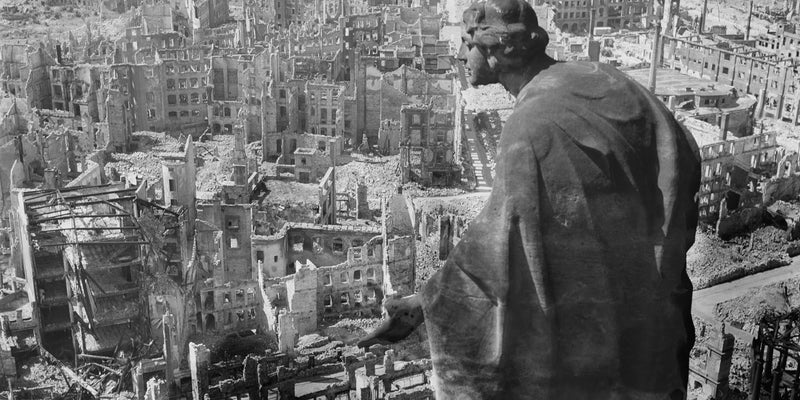
Today is the eighty-first anniversary of the Allied firebombing of Dresden during World War Two. Much more so than Hamburg, it has been a hot moral topic ever since, and I remember my surprise and anger with my Ethics course professor at the Univ of Michigan when in class one day, probably this anniversary date, he railed vehemently against our military action as atrocity and war crime.
In fact, his Business Ethics course required a researched term paper, and I wrote mine on the subject, taking strong issue with his view. Because my vehemence was equal to his, but in the opposite direction, I, rather defiantly, expected a bad grade; but he graded my paper A, and also my grade for the course, which surprised me again, but impressed me to find that he was a scholar of integrity who welcomed argument, disagreement as integral to human relationships.
That was Spring semester 1963. Since then, America the Beautiful has come a long distance in the direction of Evil and has finally arrived there. But I grew up in a nation and Time when speaking out "politically-incorrect" counter to popular view was not career stopping and life threatening but part of any intelligent discourse.
As a lenten discipline several years ago, I committed to examine for myself the moral issue of our Allied firebombing of German cities toward the end of World War 2. That Lent I ordered and read ten or a dozen books on the subject, including books by military theorists who recorded German war production of delicate instruments and other things in Dresden; also English-translated books by German authors who'd experienced the firebombings as children or young people; and also including Kurt Vonnegut's "Slaughterhouse Five," which is based on his experience of the event as a prisoner of war housed in a building (Schlachthof fünf - - Slaughterhouse Five) in the stockyards of Dresden, and ordered to help in clean up work immediately after.
That, my lenten project for the season, actually confirmed my existing view, and rattled my memories of our warTime hatred of Germany, Germans, and all things German and Japanese: we had euphoria in victory against barbaric enemies and no pity for their suffering, even the innocent among them. In fact, it took me my whole life to overcome and turn around my own personal animosity toward them, especially toward Germany as I vividly recall the horror of NewsReels at the end of the war showing ovens with open doors and charred skeletons inside, and mounds of naked, grotesquely twisted, rotting corpses in the concentration camps. My hatred is a memory and a glowing ember deep in my mind, that is easy to stir up and burst into flame if I don't sit on it.
Yes, I have guilt in my feelings, but criticize me in your rear-view mirror ONLY you were there too. America is an English-speaking, not a German-speaking country today only because of all that we did in that war. And even though I see in our national life and political atmosphere here and now, outrages reminiscent of what Brought the Third Reich to power and ruin.
So, today is a personal This Day in History for me.
But personal in two ways, two different topics. What I actually started out to muse on was the evil of religious certainty, also coming to mind as I read Today In History online in my email: today is also a date for Galileo: arriving in Rome in 1633 to face capital charges of heresy for saying that the earth revolves around the sun, counter to Church doctrine that Earth was the center of Creation, the sun and all stars revolved around the Earth. It's a "subject" with me because the evil of religious certainty in blind ignorance is as alive today as it was in Galileo's day and age. Not only among religious fanatics on the nut-case fringe, but among everyday people, "Faith" is mistaken for knowledge, enforced legally when the nut-case-fringe attains political power, and stomps down anyone in other than their own faith community. It's anywhere and everywhere that the religious attitude is "you have to go by what we believe/know for certain is True."
+++++++
Enough of that, my own pet peeve railing. Below are the two essays from This Day In History that set me off.
Both essays are inadequate. The piece about Galileo fails to mention what the Church in its wicked certainty did to Giordano Bruno, Galileo's early contemporary who had been found guilty of the same heresy and burned horribly at the stake.
And I cut the Dresden piece short because it wandered off into Monday morning quarterbacking moral judgment of our warTime action against an enemy nation and Volk whose monstrous evil exceeded anything in human history.
So, welcome, Dear Reader, though you and I are sure to disagree on almost everything, and +Time is my blog, isn't it.
T90
Galileo arrives in Rome to face charges of heresy

On February 13, 1633, Italian philosopher, astronomer and mathematician Galileo Galilei arrives in Rome to face charges of heresy for advocating Copernican theory, which holds that the Earth revolves around the Sun. Galileo officially faced the Roman Inquisition in April of that same year and agreed to plead guilty in exchange for a lighter sentence. Put under house arrest indefinitely by Pope Urban VIII, Galileo spent the rest of his days at his villa in Arcetri, near Florence, before dying on January 8, 1642.
Galileo, the son of a musician, was born February 15, 1564, in Pisa, in what is today known as Italy. He entered the University of Pisa planning to study medicine, but shifted his focus to philosophy and mathematics. In 1589, he became a professor at Pisa for several years, during which time he demonstrated that the speed of a falling object is not proportional to its weight, as Aristotle had believed. According to some reports, Galileo conducted his research by dropping objects of different weights from the Leaning Tower of Pisa. From 1592 to 1630, Galileo was a math professor at the University of Padua, where he developed a telescope that enabled him to observe lunar mountains and craters, the four largest moons of Jupiter and the phases of Venus. He also discovered that the Milky Way was made up of stars. Following the publication of his research in 1610, Galileo gained acclaim and was appointed court mathematician at Florence.
Galileo’s research led him to become an advocate of the work of the Polish astronomer Nicolaus Copernicus (1473-1543). However, the Copernican theory of a sun-centered solar system conflicted with the teachings of the powerful Roman Catholic Church, which essentially ruled Italy at the time. Church teachings contended that Earth, not the sun, was at the center of the universe. In 1633, Galileo was brought before the Roman Inquisition, a judicial system established by the papacy in 1542 to regulate church doctrine. This included the banning of books that conflicted with church teachings. The Roman Inquisition had its roots in the Inquisition of the Middle Ages, the purpose of which was to seek out and prosecute heretics, considered enemies of the state.
Today, Galileo is recognized for making important contributions to the study of motion and astronomy. His work influenced later scientists such as the English mathematician and physicist Sir Isaac Newton, who developed the law of universal gravitation. In 1992, the Vatican formally acknowledged its mistake in condemning Galileo.
++++++++++
|
|